
Representatives from SpaceX, Blue beginning, and United Launch Alliance participated in a forum remaining week held by means of NASA to check the future of humans on the moon. This isn't just how they're going to live, how lengthy they are going to live, or what they are going to do; no, this is way more wonderful: this became how people will commute from lunar orbit from the surface of the moon. The future of the next era of lunar lander is being decided at the moment.
The plan at the moment is entirely not like Apollo, which sent a pair of spaceships in orbit around the moon, despatched one to the floor, then back to the mom ship for the trip lower back to Earth. in its place of something just a little elementary, the subsequent era of lunar exploration will ensue from a gateway orbiting in cis-lunar space. What makes this so impressive is how bizarre the orbit is, and the causes in the back of it.
It's The Orbit That's specialby using now, most of us should still know how the Apollo missions went. The Saturn V took off from the cape, went around the Earth for an orbit or so, and then re-lit its engine to send it off to the moon. After a 3-day event, the Apollo command module entered a nearly equatorial orbit, sent the lunar lander on its method, waited a day or two or three, docked, after which sped returned to Earth. The equator is the least difficult place to land on the moon, and the first three Apollo missions to accomplish that — Apollo 11, 12, and 14 — all landed within a couple of levels of the lunar equator. Later missions ventured farther north, but best to this point: Apollo 15 landed at 26° North latitude. certain, we've explored the moon, but it's like announcing you've explored the Earth if you've handiest been as far North as Florida. There's unique stuff in additional temperate climes, and on the moon particularly so: there is water ice below craters on the lunar poles.
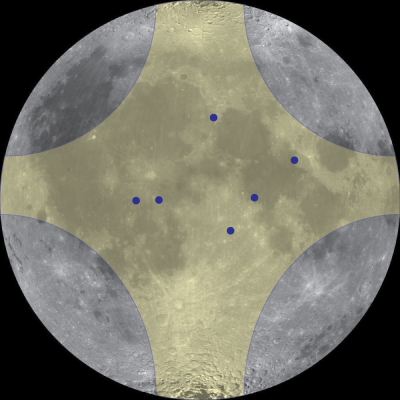 feasible landing websites of Apollo, highlighted. Apollo could not land at mid-latitudes with Earth low on the horizon. also proven: the landing websites for manned Apollo missions
part of this become as a result of the know-how on the time. Apollo might, theoretically, land at the poles. It could additionally land on the equator. Mid-latitudes were difficult; to get to these latitudes, the command module would need to orbit at an inclination that's equally far away from 0 as it is from ninety. certain, you could take an Apollo lunar lander down to the moon at 45° North, with the Earth low on the horizon, but to get returned, you'd need to rendezvous with the command module. That too could ensue, however then you'd be caught. Apollo with no trouble wasn't developed for landing at mid-latitudes with the Earth low on the horizon.
bound, it's rocket science, but so is playing Kerbal house application. With Kerbal space core on the equator, and the Mun in a 0 degree inclination orbit, you don't should feel too complicated about getting to the Mun. in case you wish to go to latitudes other than the Armstrong memorial or the munar arch just north of East crater, it takes a little greater work.
note the equal additionally applies to previous, expertise landing sites of Apollo missions. When Harrison Schmitt cautioned landing on the far side of the moon the usage of a relay satellite to send transmissions round a few thousand miles of rock, he counseled touchdown close the equator. It not ever took place, but the feasible landing websites of the Apollo missions become in response to the capabilities of the Apollo spacecraft.
a brand new Orbit, And A GatewayNASA's new plan for future trips to the moon don't go without delay to the moon. as a substitute, future moonwalkers will first seek advice from a 'lunar gateway' in a near-Rectilinear Halo Orbit. What's a close-Rectilinear Halo Orbit (NRHO)? That's takes a little bit to unpack, however the merits are value it.
There are solid co-orbits in any three physique equipment, and already there are a hundreds of objects in the solar device in this type of configuration. As a idea experiment, imagine your self on the surface of the solar. directly above you, about 5 AU away, is Jupiter. in case you had been to attract an equilateral triangle with legs five AU long, you'd locate a gaggle of asteroids trailing and main Jupiter. These are the Trojan asteroids, and due to Jupiter's big mass, these asteroids are in a really solid orbit. They're additionally orbiting a Lagrange element, in this case L4 (orbiting earlier than Jupiter) and L5 (after Jupiter). There are three greater aspects that are solid in any orbit, however the important ones are L1 and L2. in the solar-Earth equipment, these elements are for photo voltaic monitoring satellites, and finally the James Webb space telescope can be putting around Earth-solar L2, or in Earth's shadow, about 1,000,000 miles away.
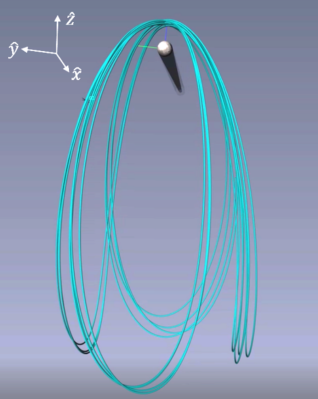 The near-Rectilinear Halo Orbit, headquartered on the moon. photo credit
whereas there is a mathematical reality of Lagrange aspects, in apply it's a lot simpler to orbit these points. That's precisely what the lunar gateway will do. The near-Rectilinear Halo Orbit is a special case of the Earth-Moon L2 orbit that in the beginning seems to be an odd polar orbit of the moon, with one orbit taking between 6 and eight days.
From a simplistic aspect of view, the NRHO seems like a particularly eccentric polar orbit across the moon, with a periapsis of about 2,000 miles, and an apoapsis of about ten times that. This orbit isn't a lunar orbit, though. Mathematically, it's still an orbit across the Earth-Moon L2 factor. It takes a little extra energy to get to than a lunar orbit, nevertheless it offers some wonderful benefits. It's effortless to access with launch vehicles either currently flying, or in checking out, it's in a good region for Earth, solar, and deep-space observations and speaking with Earth, and NRHO orbits can be used as relay stations for operations on the moon's far facet.
due to the fact here is an orbit round Earth-Moon L2, it is inherently unstable, and should require just a little of gasoline to maintain the orbit. That's an issue, however because the Apollo science packages found, well-nigh all orbits around the moon are unstable and would require fuel to hold orbit.
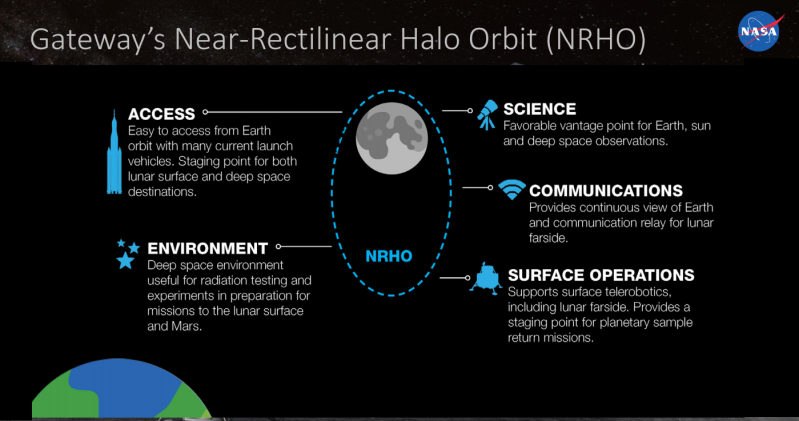 photo source
quickly, there can be a space station orbiting somewhere around the moon. It's no longer really in lunar orbit, despite the fact if you looked at it long enough it might seem adore it. this is the orbit that could be the first stopping element on the way to the moon, and in contrast to the Apollo missions, this lunar gateway can be capable of take us anyplace, even if it's to the water ice trapped below the poles, to the some distance side of the moon, or to revisit the historic landmarks of the Apollo and Surveyor landing sites.

