
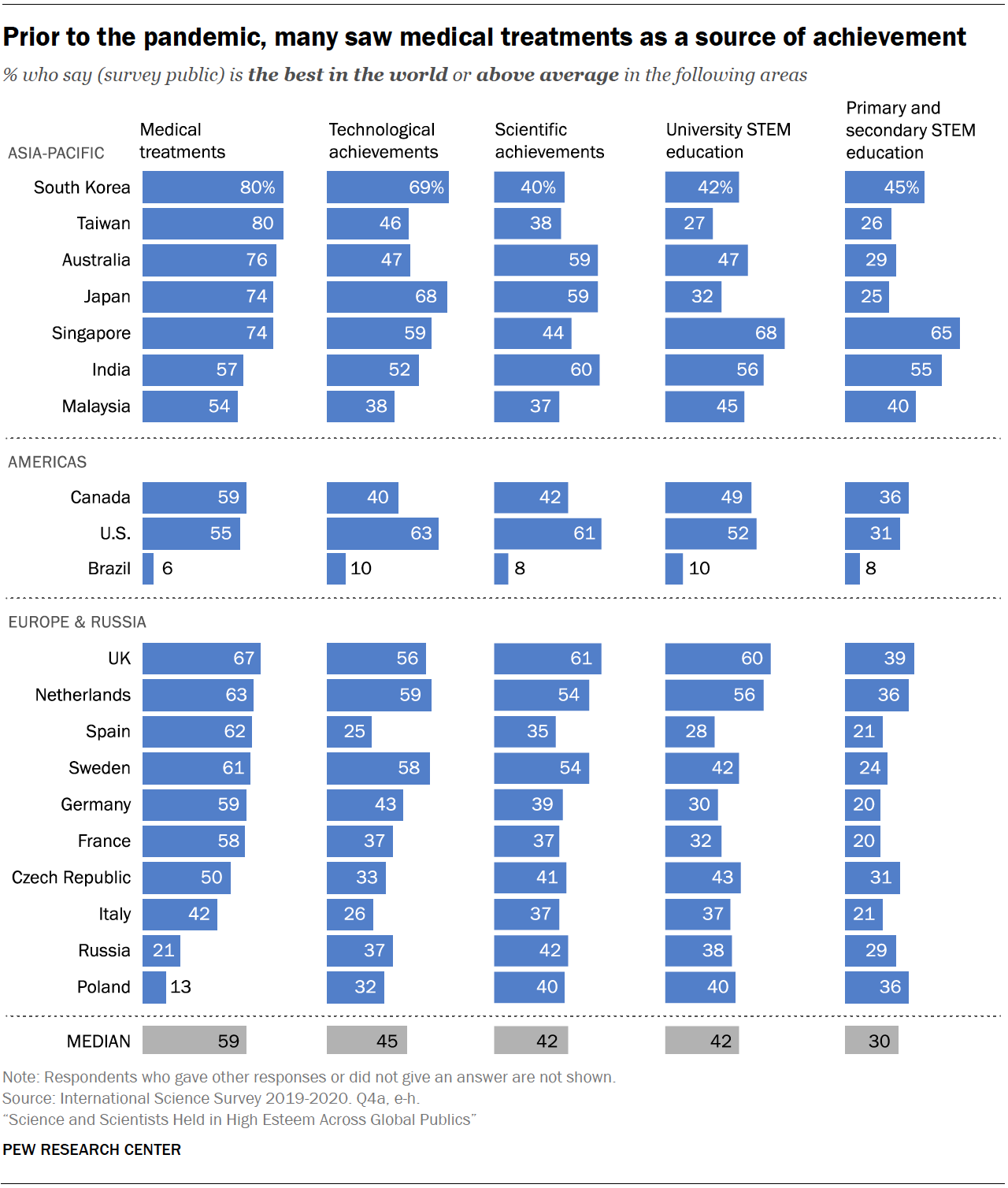
searching throughout the 20 publics surveyed, majorities considered their scientific treatments to rank above those of different publics globally. Views of scientific cures were often considered more favorably than achievements in different areas, together with science, expertise, STEM education, politics and the economic climate. within the U.S., despite the fact, 61% talked about their scientific achievements were at least above average, while greater – 55% – spoke of the equal about their medical remedies. And in India, in a similar fashion sized majorities noticed their nation as above regular or the most effective on the planet across a couple of areas. (The survey became conducted earlier than the coronavirus outbreak reached pandemic proportions.)
massive majorities saw cost from executive investment in scientific research, saying that such funding is usually rewarding for society over time. Majorities also commonly regarded it at the least a bit important to be a global chief in scientific research. but the share who regarded their scientific achievements at least above average commonly lagged in the back of the share announcing it turned into very critical to be a world leader in science.
Many see their scientific cures in a positive mild; fewer say the same about STEM training for basic and secondary school college studentsthroughout the 20 publics, a median of 59% say their scientific treatments are at the least above average, with one of the vital optimum scores in the Asia-Pacific location. In South Korea and Taiwan, as an example, eighty% say their clinical remedies are at the least above regular. against this, handiest 6% in Brazil and 13% in Poland believe their medical remedies are the top-quality on earth or above ordinary.
Medians of forty five% and forty two% say their technological and scientific achievements are at the least above typical, respectively. Perceptions of areas of relative power vary through public. within the UK, the U.S. and Japan, majorities give positive scores to each their technological and scientific achievements. In South Korea and Singapore, majorities consider their technological achievements are at the least above commonplace, but fewer than half say the same about scientific achievements. In Australia the opposite sample happens, with a smaller share giving their technological than scientific achievements excessive marks.
When it comes to schooling in science, know-how, engineering and math (STEM), a median of forty two% see their publics' tuition STEM practicing as above typical or the premiere on this planet. scores are far decrease when it involves STEM schooling on the primary and secondary faculty stages: across the 20 publics surveyed, a median of 30% view the STEM education at these tiers as at least above average.
Singaporeans stand out for their strongly fine ratings of their STEM education: sixty five% fee their STEM training in simple and secondary schools as at the least above common. The city-state normally ranks at or near the correct in math and science on the Programme for foreign pupil assessment (PISA) of 15-yr-olds. Singapore is additionally certainly one of handiest a handful by which a majority (sixty eight%) rates their tuition STEM schooling as at the least above typical, along with the united kingdom (60%), the Netherlands (fifty six%) and India (fifty six%).
throughout all areas of fulfillment, scores are primarily low in Brazil. simply 10% or fewer believe their scientific cures, technological or scientific achievements and STEM schooling to be at the least above standard. A majority of Brazilians (63%) agree with their scientific remedies to be under ordinary; 41% say the equal about the nation's scientific achievements. Brazilians' views of the political and economic gadget are additionally fairly terrible. Fewer than one-in-ten say their country is the most desirable on earth or above regular in these areas; majorities say each is below regular in comparison with different countries.
 those with more education are inclined to see their STEM-related achievements in a greater favorable gentle
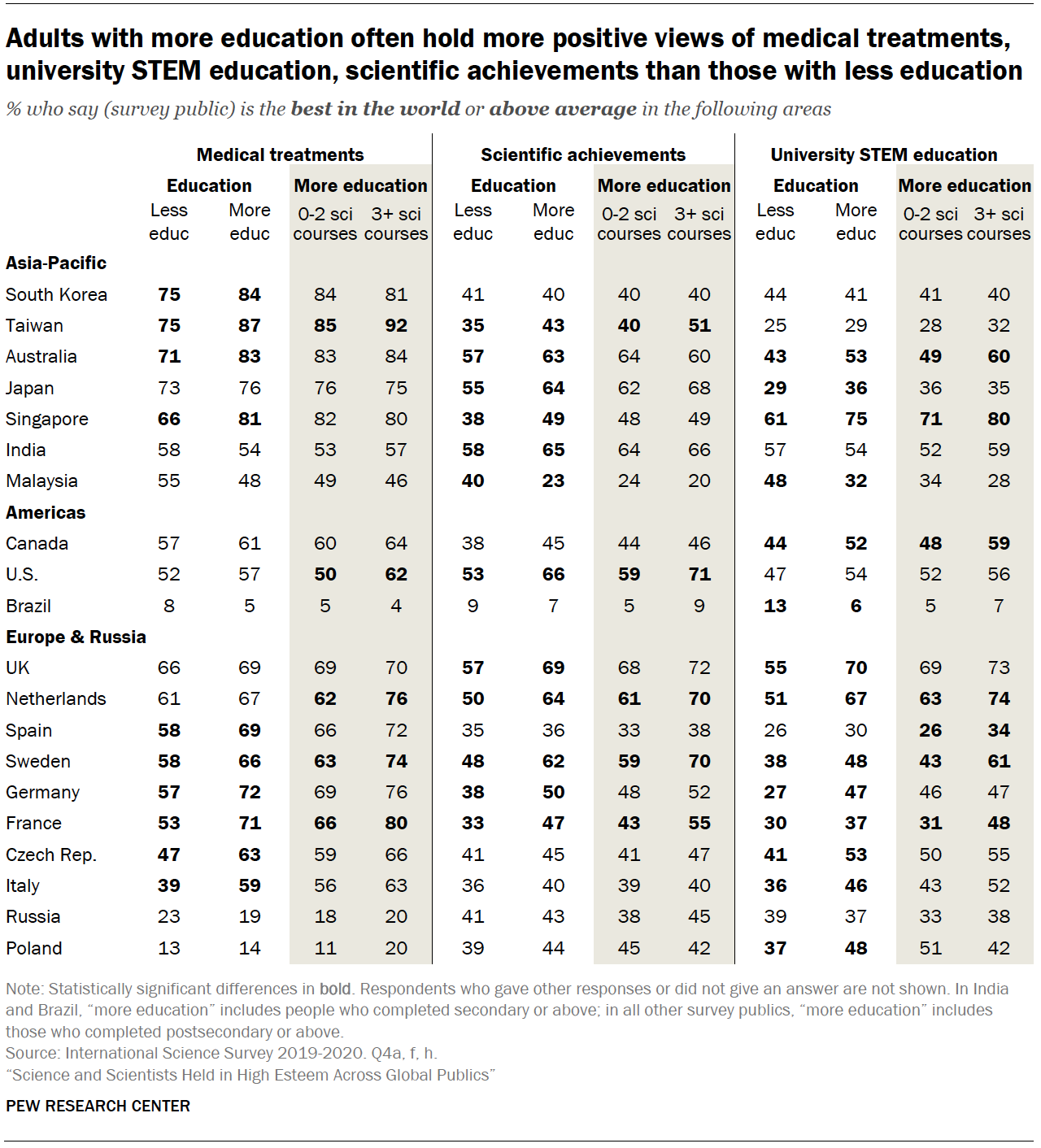
 across the 20 publics, those with greater training often rank their clinical remedies, college STEM training and scientific achievements extra totally than these with much less schooling. as an example, seventy two% of Germans with a postsecondary education or extra consider the nation's scientific treatments are at the least above general in comparison with fifty seven% of those with less training. Germans with more education are additionally extra inclined than those with less education to claim their university STEM training (forty seven% vs. 27%) and scientific achievements (50% vs. 38%) are the most useful on earth or above commonplace.
Malaysia stands out because the handiest survey public during which the pattern is reverse. Malaysians with at least a postsecondary schooling are less probably than others to look the nation's school STEM training or scientific achievements in a positive easy. Malaysians with a postsecondary education additionally tend to provide lower marks to the nation's technological achievements as well as to its political device and economy.
whereas higher stages of training are often linked to extra superb views of STEM-connected achievements, postsecondary science practising itself isn't perpetually tied to changes in these assessments. as an example, among these with a postsecondary education in Japan, 75% of folks that took three or greater science courses say their scientific cures are above standard or the greatest on earth, compared with about as many (76%) who took zero to 2 science classes.
The absence of a relationship between postsecondary science practising and rankings of medical cures, scientific achievements and college STEM education is viewed throughout many survey publics. although, Sweden, France and the Netherlands are exceptions to this familiar sample. In these areas, folks that have as a minimum a postsecondary training and who've completed three or extra school-level science lessons are greater superb about the best of their nation's scientific cures, university-degree STEM schooling and scientific achievements than postsecondary graduates with less science working towards.
in lots of places, guys are greater probably than ladies to extremely rank their countries' accomplishments throughout a range of STEM-linked areas, principally in Europe. as an example, in the Netherlands, men are greater doubtless than women to claim their nation is at the least above standard in institution STEM education (20 percent element difference), clinical remedies (through 18 points) and scientific achievements (18 features). There are identical variations between men and ladies within the rankings of clinical cures, school STEM schooling and scientific achievements in France, Italy, Germany and the united kingdom. See details in Appendix A.
Majorities see executive investments in scientific analysis as valuable; half or greater believe being a world leader in science is vital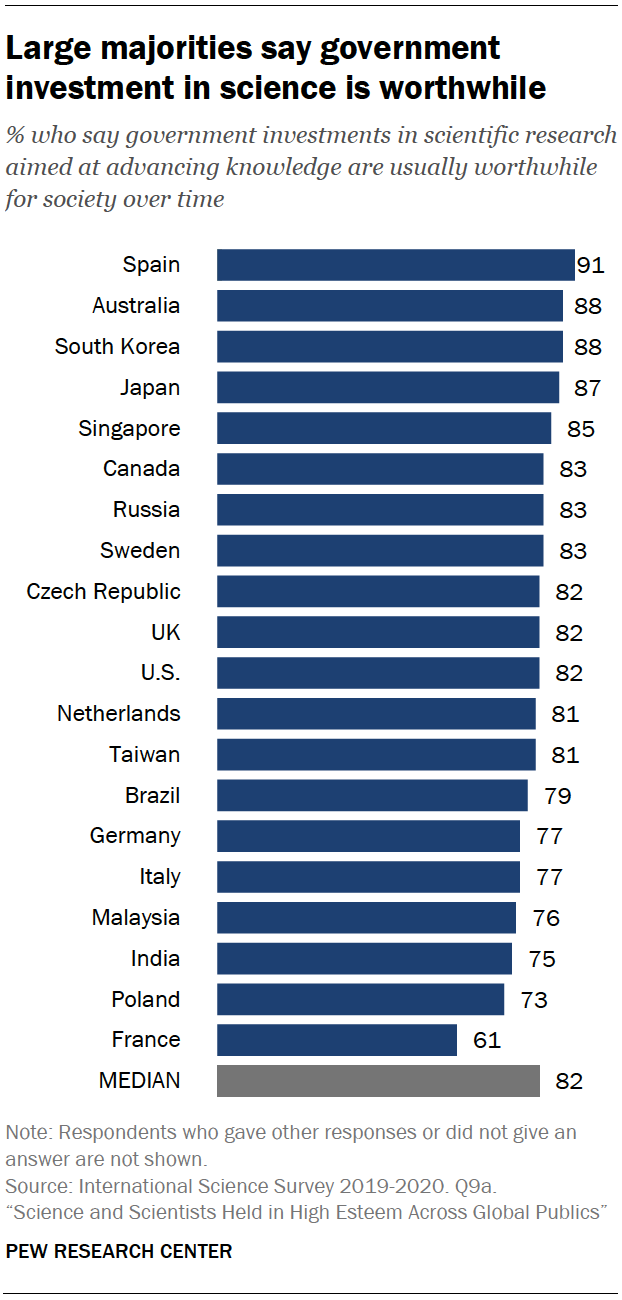 normal, there is wide agreement among these 20 publics that govt investment in scientific analysis is worthwhile. significant majorities in most publics surveyed say that government funding in scientific research aimed at advancing talents is usually worthwhile for society over time. throughout all areas surveyed, a median of 82% say this.
further, majorities in all publics agree that being a global leader in scientific success is at least slightly vital. the share who view this as very crucial varies by public. A 20-public median of 51% location the maximum level of magnitude on being a science world leader.
Assessments of the place each public stands in its scientific achievements commonly lag at the back of the shares who aspire to be an international leader in science.
 for instance, seventy two% of Spaniards agree with it very critical to be a global chief in scientific success, but simply 35% consider their country's scientific achievements are the most fulfilling on this planet or above usual.
In a few areas, the opposite sample happens. among the many Dutch, for instance, just 21% say it is very essential to be a science world leader, while greater than twice as many (54%) consider the nation to be as a minimum above general in its scientific achievements.
people with higher degrees of education are greater doubtless than these with reduce tiers of schooling to think govt investments in scientific analysis are rewarding. there is a major difference in views with the aid of level of education in 18 of the 20 publics surveyed.
In eight of 20 publics, americans with greater training are more likely than those with much less schooling to assert it is terribly critical to be an international leader in scientific achievements.
amongst these with larger ranges of schooling, there is little change in views on these two questions between those that have taken three or more science lessons and people with much less science training. See particulars in Appendix A.

