
Supriya Chakrabarti is a professor of physics at university of Massachusetts, Lowell. this article changed into at the beginning published at The dialog. The booklet contributed the article to space.com's professional Voices: Op-Ed & Insights.
The democratization of space started two decades in the past with Beanie children – or, greater precisely, the clear acrylic box that brought them home. These four-inch (10-cm) cubes impressed space engineer Bob Twiggs to create CubeSat, the primary satellite tv for pc with a common design.
From 1957 when the first human-made satellite tv for pc, Sputnik-1, changed into launched unless 1999 when Twiggs proposed CubeSat, satellites came in all sizes and styles. And almost all satellites had been designed from scratch. CubeSat offered the first universally approved satellite tv for pc usual – a cube with 4-inch aspects and weighing about three kilos (1.three kilograms).
When Twiggs' conceived the thought of CubeSat, called 1U, his intention changed into to introduce engineering students to satellite tv for pc design notwithstanding palms-on practising. Their task became to develop and behavior a complete space mission with Sputnik-1-like capabilities. Now, to meet the calls for of greater advanced functions, distinct 1U CubeSats will also be combined to kind better programs that are referred to as 2U, 3U and the like.
i'm a professor of physics on the university of Massachusetts, Lowell, and have designed and flown many spaceflight experiments to analyze phenomena corresponding to space climate, which probes the outcomes of solar storms on a considerable number of technologies we count on for everyday life comparable to radio communique and navigation. I've also designed technologies vital to represent the exoplanets around nearby stars. I now have the ability to share my abilities and inspire a new technology of space engineers by using instructing undergraduate students the way to design CubeSats, which might eventually be launched into house.
CubeSat and P-POD: The video game changersFor more than 50 years entry to area changed into prohibitively costly and best nations and massive corporations with large amenities and an skilled cadre of engineers may finance these ventures. That modified in 1999 when aerospace engineer Jordi Puig-Suari and Twiggs delivered the Poly Picosatellite Orbital Deployer (P-POD), a typical launching equipment for house-primarily based CubeSat. each and every P-POD incorporates between one and three CubeSats, which in flip, are positioned in orbit with the aid of launchers carrying science or commercial payloads. Most foremost launchers usually have excess ability and permit such ridesharing. as soon as in space, P-PODs set up their satellites.
CubeSats have now develop into a mainstay in commercial applications. In 2017, an Indian booster offered rides to a listing 103 nanosatellites – which weigh between 2 and 22 kilos (1 and 10 kilograms). what's even more brilliant is that a 3-12 months-historical company, Planet, has developed and launched 88 3U CubeSats for imaging purposes.
Globally, the space economic climate is thriving. NASA's budget is only a fraction of the united states$345 billion world space business. As a society we have come to rely on techniques in area for a lot of facets of universal life from verbal exchange to assessing climate change and from international security to innovation.
scholar designed CubeSatsthe whole variety of nanosatellites in area has already exceeded 1,000. it's therefore effortless to predict high demand for professional space scientists and technologists sooner or later. however how do educators instruct them?
One promising reply is that universities, institutes, nonprofit groups and even people are designing and building nanosatellites. Recognizing the want for capability building, NASA covered CubeSats in its 2015 demand college scholar Instrumentation program. This ongoing program goals to provide undergraduate scholar groups opportunities to design all elements of an area mission. The students are expected to construct, fly and operate their missions in space, bring together facts and emerge with the imperative competencies to address bigger initiatives.
My group turned into fortunate to be selected for this application. four undergraduate college students helped write our CubeSat suggestion. We designed a mission, referred to as space HAUC so that it will demonstrate a brand new communication equipment able to steerage beams of information to a ground station at speeds of fifty-one hundred Mbps, greatly faster than from most CubeSats.
This know-how could alleviate probably the most key technical bottlenecks of CubeSat-based imaging missions: a big quantity of statistics. It is not effortless to transmit so lots facts the use of the general information channel, S-band (2-four GHz), which is purchasable for NASA science missions. X-band communication (eight-12 GHz) would enable transmission of 10-20 times the data rate commonly viewed in CubeSats, opening up new capabilities.
My college students recruited the members of their group and organized themselves into practical teams. similar to in a real mission, they cling typical design and assignment meetings, participate in NASA-mandated studies and involve school and workforce best when vital. They generated computer simulations of each and every subsystem, developed prototypes before manufacturing and, in some instances, purchased commercially purchasable subsystems that met their wants. The comprehensive CubeSat will be assembled and may bear pre-flight exams this summer season for a trip to the overseas area Station (ISS) in early 2020. area HAUC may be launched into its orbit from the ISS.
We should still beginning receiving some data in regards to the fitness and security facts of the satellite inside a day of launch from the station. The science and technical records may still observe a few weeks after that.
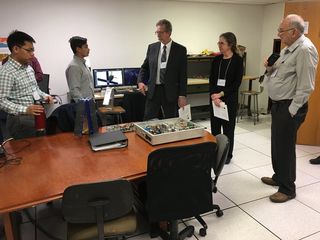
The area HAUC group describing their undertaking to exceptional friends. From left, undergraduate students Simthyrearch Dy, venture supervisor, and Sanjeev Mehta, verbal exchange systems lead. The guests encompass James green, NASA chief scientist, Megan Donahue and Bob Twiggs, inventor of CubeSat.
(photograph: © Supriya Chakrabarti, CC by means of-SA)
In his may additionally 25, 1961 speech to Congress, President Kennedy referred to, "We go into area because whatever thing mankind should undertake, free guys should thoroughly share." The Google Lunar X-Prize competitors spurred international enthusiasm in inner most area. while no group met the 2018 time limit, the Beresheet lander by means of SpaceIL, one of the crucial finalists, got here tantalizingly shut. With individuals, school students and their younger counterparts touching space, we're very near President Kennedy's imaginative and prescient.
The genie is out of that clear acrylic field.
this article is republished from The conversation below a inventive Commons license. study the long-established article.
follow all the knowledgeable Voices concerns and debates — and turn into part of the dialogue — on facebook, Twitter and Google +. The views expressed are those of the writer and don't always replicate the views of the publisher. This version of the article was firstly posted on house.com.

